Thursday, 4 August 2011
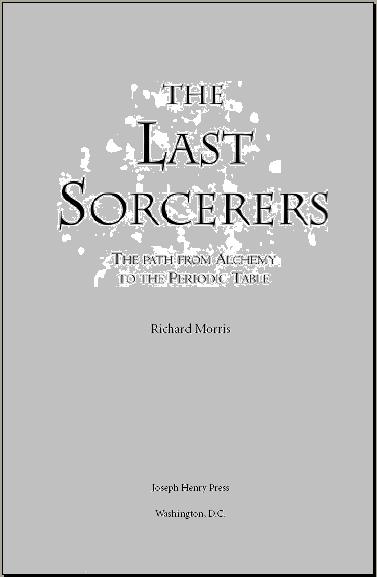
The Last Sorcerers: The Path from Alchemy to the Periodic Table
Though the stories in this volume have been told before in other books, Morris (The Evolutionists; Time's Arrow) manages to make the history of the periodic table's conception fresh and quirky one more time. He does this by focusing his narrative on the early alchemists, who were among the first scientists to investigate the composition of metals and who were widely perceived to be near-sorcerous practitioners of mysterious arts.
http://www.filesonic.com/file/1585982481/2401.rar
String Theory and M-Theory: A Modern Introduction
String theory is one of the most exciting and challenging areas of modern theoretical physics. This book guides the reader from the basics of string theory to recent developments. It introduces the basics of perturbative string theory, world-sheet supersymmetry, space-time supersymmetry, conformal field theory and the heterotic string, before describing modern developments, including D-branes, string dualities and M-theory.
http://www.filesonic.com/file/1584722724/0521860695.djvu
The Science of Astrobiology
Since the publication of The New Science of Astrobiology in the year 2001—the first edition of the present book—two significant events have taken place raising the subject from the beginning of the present century to its present maturity. Firstly, in 2001 the Galileo Mission still had two years to complete its task, which turned out to be an outstanding survey of the Jovian system, especially of its intriguing satellite Europa. Secondly, the Cassini Huygens Mission was still on its way to Saturn. Its present success has surpassed all expectations of ESA and NASA. Astrobiologists still did not know that Titan was the fifth body in the Solar System that possibly contained a water ocean (including the Earth and the three Galilean satellites other than Io). For these reasons the book includes overviews of the evolutionary and molecular biology that are necessary. There is a discussion of other sectors of culture that are the natural frontiers of astrobiology, especially the humanities.
http://www.filesonic.com/file/1586210874/9400716265Astrobiology.pdf
The Neurophysics of Human Behavior
How do brain, mind, matter, and energy interact? Can we create a comprehensive model of the mind and brain, their interactions, and their influences? Synthesizing research from neuroscience, physics, biology, systems science, information science, psychology, and the cognitive sciences, The Neurophysics of Human Behavior advances a unified theory of brain, mind, behavior and information.
http://www.filesonic.com/file/1586872621/2608.rar
What is this thing called Knowledge? [2nd Edition]
What is Knowledge? Where does it come from? Can we know anything at all? This lucid and engaging introduction grapples with these central questions in the theory of knowledge, offering a clear, non-partisan view of the main themes of epistemology including recent developments such as virtue epistemology and contextualism.
Duncan Pritchard discusses traditional issues and contemporary ideas in thirteen easily digestible sections, including:
• the value of knowledge
• the structure of knowledge
• virtues and faculties
• perception
• testimony and memory
• induction
• scepticism.
http://www.filesonic.com/file/1590046461
No Ordinary Genius: The Illustrated Richard Feynman
This is not a biography of Nobel Laureate Feynman-the gold standard for that is unquestionably James Gleick's Genius (LJ 10/1/92)-but rather a very interesting and pleasing compilation of anecdotes, interview excerpts, and conversations by a man who has made several excellent films about and with Feynman-including The Pleasure of Finding Things Out and No Ordinary Genius. Even for those who think they know Feynman and his work, this book is a rare and touching glimpse of him in his own words and in the words of those who knew him best. A pleasure to look through (there are more than 100 photos) and read and an excellent book for general and popular collections. A browser's delight.
http://www.filesonic.com/file/1584722624/039331393X.djvu
Fins into Limbs: Evolution, Development, and Transformation
Long ago, fish fins evolved into the limbs of land vertebrates and tetrapods. During this transition, some elements of the fin were carried over while new features developed. Lizard limbs, bird wings, and human arms and legs are therefore all evolutionary modifications of the original tetrapod limb.
A comprehensive look at the current state of research on fin and limb evolution and development, this volume addresses a wide range of subjects—including growth, structure, maintenance, function, and regeneration. Divided into sections on evolution, development, and transformations, the book begins with a historical introduction to the study of fins and limbs and goes on to consider the evolution of limbs into wings as well as adaptations associated with specialized modes of life, such as digging and burrowing. Fins into Limbs also discusses occasions when evolution appears to have been reversed—in whales, for example, whose front limbs became flippers when they reverted to the water—as well as situations in which limbs are lost, such as in snakes.
http://www.filesonic.com/file/1592354384/0226313379FinsLimbs.pdf
Subscribe to:
Posts (Atom)